
HiPIMS
HiPIMS – High Power Impulse Magnetron Sputtering
High Power Impulse Magnetron Sputtering (HiPIMS) is an advanced physical vapor deposition (PVD) technique used for thin-film coatings.Unlike conventional magnetron sputtering, HiPIMS delivers high-power pulses in short bursts, creating a dense plasma with a high degree of ionization. This results in superior film quality, improved adhesion, and enhanced material properties, making it ideal for applications in industries such as electronics, optics, and protective coatings.
While HiPIMS offers significant advantages over traditional sputtering methods, one challenge has been its lower deposition rates. To address this, combinatorial processes that integrate HiPIMS with DC or Medium Frequency (MF) sputtering can be used, achieving higher deposition efficiency without compromising film quality. Synchronizing HiPIMS pulses with DC or MF power sources enhances plasma stability, increases coating uniformity, and allows for greater control over material properties. As a result, industries relying on precise thin-film coatings, such as semiconductor manufacturing and optical applications, benefit from improved adhesion, durability, and performance.
Sie sehen gerade einen Platzhalterinhalt von YouTube. Um auf den eigentlichen Inhalt zuzugreifen, klicken Sie auf die Schaltfläche unten. Bitte beachten Sie, dass dabei Daten an Drittanbieter weitergegeben werden.
Mehr InformationenHiPIMS offers several advantages over traditional magnetron sputtering techniques:
- Higher ionization: HiPIMS generates a highly ionized plasma, leading to better film density and adhesion compared to conventional sputtering.
- Improved coating quality: The process produces smoother, denser, and harder coatings, reducing defects and enhancing durability.
- Better control over film properties: HiPIMS allows precise manipulation of deposition parameters, enabling tailored coatings for specific applications.
- Enhanced adhesion: The high-energy ions improve bonding between the coating and substrate, making it ideal for demanding applications.
- Reduced thermal load: Unlike continuous sputtering, HiPIMS operates in short pulses, minimizing heat buildup and making it suitable for temperature-sensitive substrates.
HiPIMS is widely used across various industries for advanced thin-film coatings:
- Corrosion-resistant coatings: HiPIMS is used to deposit nanoscale multilayers like CrN/NbN, which enhance durability.
- Optical coatings: Materials such as TiO₂, ZnO, and Ag are deposited using HiPIMS for applications in lenses, mirrors, and display technologies.
- Microelectronics: HiPIMS is employed to deposit materials like Cu, Ti, TiN, Ta, and TaN, which are essential for semiconductor manufacturing.
- Hard coatings: Used for wear-resistant coatings, including carbon nitride (CNx) and Ti-C nanocomposites, improving tool longevity.
- Industrial applications: HiPIMS is utilized for protective coatings in manufacturing, enhancing adhesion and hardness
Unipolar HiPIMS
Unipolar HiPIMS applies high-power pulses with a single polarity to a single cathode, creating a dense plasma that enhances ionization and energy transfer to the sputtered material. Both planar and rotatable cathodes can be used.
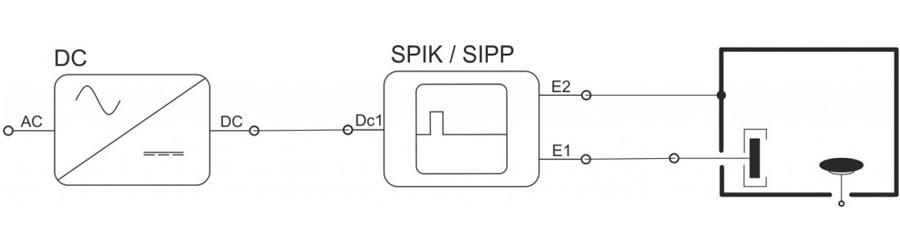

Bipolar HiPIMS
Bipolar HiPIMS alternates between positive and negative pulses, balancing charge accumulation and reducing arcing. This technique enhances deposition rates and improves coating uniformity, making it ideal for complex material systems.


HiPIMS + DC
HiPIMS is known for its high ionization rates, leading to smoother and denser coatings. However, one challenge has been its lower deposition rate compared to conventional DC sputtering. To address this, a HiPIMS + DC combinatorial approach has been developed, where DC power is superimposed onto HiPIMS. This method enhances deposition efficiency while maintaining the superior film properties of HiPIMS. The integration of DC power allows for higher coating rates, making it a practical solution for retrofitting existing DC sputter processes with HiPIMS technology.
Comparing HiPIMS with DC Coatings

Combining DC sputtering with HiPIMS offers several advantages:
- Higher deposition rates: DC power compensates for HiPIMS‘ lower deposition efficiency, enabling faster coating processes.
- Improved film quality: HiPIMS enhances ionization, leading to smoother, denser, and more uniform coatings compared to conventional DC sputtering.
- Cost-effective retrofitting: Existing DC sputter systems can be upgraded with HiPIMS technology using a diode matching network, making integration simple and efficient.
- Better process control: The combination allows for precise tuning of pulse parameters, optimizing coating properties for specific applications.
- Versatile applications: This approach is beneficial for large-area coatings, optical films, wear-resistant layers, and semiconductor manufacturing.
HiPIMS + MF
The combination of HiPIMS with Medium Frequency (MF) sputtering enhances deposition efficiency while maintaining the superior film properties of HiPIMS. By integrating MF power, the process stabilizes plasma conditions, reduces arcing, and increases deposition rates. This approach is particularly beneficial for applications requiring high-quality coatings with improved adhesion and uniformity, such as optical films, wear-resistant layers, and functional coatings for industrial use. The synergy between HiPIMS and MF sputtering allows for greater flexibility in tailoring material properties, making it a valuable technique for advanced thin-film deposition.

The combination of HiPIMS with MF sputtering offers several advantages:
- Higher deposition rates: MF power helps compensate for HiPIMS lower deposition efficiency, making the process more viable for industrial applications.
- Improved plasma stability: The integration of MF sputtering reduces arcing and enhances process control, leading to more uniform coatings.
- Enhanced film properties: The synergy between HiPIMS and MF results in coatings with superior adhesion, density, and surface smoothness.
- Greater flexibility: This approach allows for tailored material properties, making it suitable for applications in optics, wear-resistant coatings, and functional films.
HiPIMS + BIAS
Enhancing thin-film coatings with HiPIMS + Bias allows for greater control over film properties. Applying bias voltage during deposition improves adhesion, density, and structural precision, making it ideal for applications that require high-performance coatings. Whether optimizing wear resistance, fine-tuning superconducting materials, or achieving uniform surfaces, this approach helps deliver reliable, high-quality results.

Using HiPIMS with bias voltage offers several key advantages:
- Improved film density: Bias voltage enhances ion energy, leading to denser coatings with fewer defects.
- Better adhesion: The increased ion bombardment strengthens the bond between the coating and substrate.
- Optimized microstructure: Bias control allows for tailored crystallinity and phase formation, improving material properties.
- Enhanced mechanical performance: Studies show that bias voltage increases hardness and wear resistance in multilayer coatings.
- Superior corrosion resistance: Negative bias improves coating uniformity, reducing porosity and enhancing protection against environmental degradation